

Blood Plasma Market Grows at 7.1% CAGR Through 2033 | Persistence Market Research
Blood Plasma Market
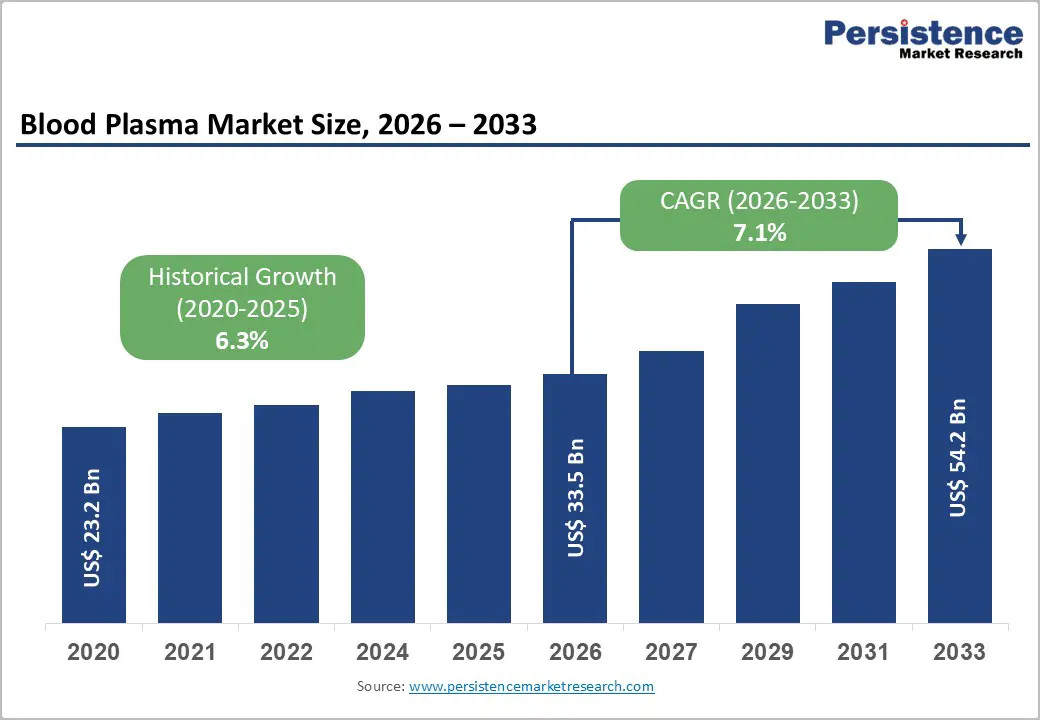
LONDON, UNITED KINGDOM, January 19, 2026 /EINPresswire.com/ -- The global blood plasma market is entering a phase of sustained expansion, supported by rising demand for plasma-derived therapies and continued investments in collection and fractionation infrastructure. The market is expected to be valued at US$ 33.5 billion in 2026 and is projected to reach US$ 54.2 billion by 2033, registering a healthy CAGR of 7.1% during the forecast period. This growth builds on a historical CAGR of 6.3% recorded between 2020 and 2024, highlighting the structurally resilient nature of plasma-based therapeutics within the broader biopharmaceutical landscape.
Plasma Characteristics and Therapeutic Importance
Plasma represents approximately 55% of total blood volume and is a complex mixture of more than 700 proteins and biologically active substances essential for maintaining physiological balance. It plays a critical role in regulating blood pressure, body temperature, and the transport of nutrients, hormones, and proteins throughout the body. Key plasma proteins such as immunoglobulins, albumin, and clotting factors form the backbone of several life-saving therapies. Plasma-derived products are indispensable in the treatment of hemophilia, immune deficiencies, autoimmune disorders, liver diseases, and severe trauma, positioning plasma as a strategic raw material in modern medicine.
Download Your Free Sample & Explore Key Insights: https://www.persistencemarketresearch.com/samples/3148
Key Industry Highlights
North America currently leads the global blood plasma market due to its extensive plasma collection network, advanced healthcare infrastructure, and strong reimbursement frameworks, particularly for immunoglobulin therapies. Asia Pacific is emerging as the fastest growing regional market, driven by increasing diagnosis of immunodeficiency disorders, rapid hospital expansion, and growing awareness of plasma-based treatments. By product category, immunoglobulins dominate global revenues owing to their broad clinical applications and chronic usage patterns, while hyperimmune globulins represent the fastest growing segment, supported by targeted therapies and rising infectious disease risks.
Market Dynamics and Growth Drivers
A major driver of market growth is the rising global burden of immunodeficiency and autoimmune disorders. Improved diagnostic capabilities have significantly expanded the identified patient population requiring long-term immunoglobulin therapy. Intravenous and subcutaneous immunoglobulins are now standard treatments across a wide range of immune-related and neurological conditions, many of which require lifelong administration. This chronic, high-volume usage structurally underpins rising plasma consumption and reinforces the revenue dominance of immunoglobulin products. Another critical growth catalyst is the expansion of plasma collection infrastructure. The United States alone operates more than 1,200 active plasma collection centers, with major players such as CSL, Grifols, Takeda, and Octapharma driving network expansion. Advanced plasmapheresis technologies are increasing yield per donation, improving cost efficiency, and enhancing supply availability for downstream fractionation.
Get Custom Insights Designed for Your Business: https://www.persistencemarketresearch.com/request-customization/3148
Market Restraints and Operational Challenges
Despite robust investments, the market continues to face supply–demand imbalances, particularly for polyvalent immunoglobulins. Any disruption in donor participation, logistics, or regulatory oversight can lead to product shortages, impacting patient access and short-term volume growth. In addition, plasma fractionation remains highly regulated and capital intensive. Stringent requirements related to donor safety, viral inactivation, traceability, and quality control increase manufacturing complexity and costs. These factors raise entry barriers, limit pricing flexibility, and moderately temper the pace of market expansion.
Emerging Opportunities and High-Growth Segments
Significant growth opportunities are emerging in the albumin segment, which is increasingly used beyond traditional indications into critical care, sepsis management, and perioperative settings. Expanding intensive care infrastructure in Asia Pacific, particularly in China and India, is accelerating albumin adoption. Additional opportunities lie in rare and chronic disorders such as hereditary angioedema, von Willebrand disease, and hemophilia, where plasma-derived clotting factors remain essential, especially in cost-sensitive markets. The development of hyperimmune globulins for targeted infectious and prophylactic applications also offers premium pricing potential and portfolio diversification for manufacturers.
Category-wise and End-User Insights
By plasma type, immunoglobulins accounted for approximately 47% of global revenues around 2025 and are expected to maintain leadership due to their extensive clinical indications and high revenue per liter of plasma. By end user, hospitals dominate the market with an estimated 55% share, reflecting their central role in acute care, complex surgeries, trauma management, and administration of high-dose plasma therapies. While outpatient infusion centers are expanding, hospitals are expected to retain clear leadership over the forecast period.
Regional Outlook
North America commands around 42% of global demand, supported by strong reimbursement, high diagnosis rates, and regulatory confidence. Asia Pacific is forecast to deliver the highest growth rate, driven by healthcare expansion, local fractionation investments, and supportive public–private initiatives aimed at improving self-sufficiency in plasma-derived products.
Companies Covered in Global Blood Plasma Market
Biotest AG
CSL
GC Biopharma Corp
Grifols
Intas Pharmaceuticals Ltd
Kedrion S.p.A.
LFB
Octapharma AG
Sanquin
Takeda Pharmaceuticals
Others
Checkout Now & Download Complete Market Report: https://www.persistencemarketresearch.com/checkout/3148
Global Blood Plasma Market Segmentation
By Plasma Type
Albumin
Factor VIII
Factor IX
Immunoglobulin
Hyperimmune Globulin
Others
By Application
Hemophilia
Immunodeficiency Diseases
Von Willebrand’s Disease
Others
By End-User
Hospitals
Clinics
Others
By Region
North America
Europe
East Asia
South Asia and Oceania
Latin America
Middle East and Africa
Recent Developments
Recent developments include Takeda’s deployment of advanced plasmapheresis technologies in the U.S. and strategic commercialization partnerships such as Biotest’s collaboration with Kedrion. Collectively, these dynamics position the blood plasma market as a high-growth, strategically critical segment within the global healthcare industry.
Read Related Reports:
NPWT Devices and Dressings Market: The NPWT devices and dressings market to grow from US$3.8 Bn in 2026 to US$6.4 Bn by 2033, registering a 7.9% CAGR driven by advanced wound care demand.
Pneumatic Compression Therapy Market: Global pneumatic compression therapy market to grow from US$630.2 Mn in 2026 to US$985.8 Mn by 2033, registering a 6.6% CAGR driven by vascular care demand.
Persistence Market Research
Persistence Market Research Pvt Ltd
+1 646-878-6329
email us here
Visit us on social media:
LinkedIn
Instagram
Facebook
YouTube
X
Legal Disclaimer:
EIN Presswire provides this news content "as is" without warranty of any kind. We do not accept any responsibility or liability for the accuracy, content, images, videos, licenses, completeness, legality, or reliability of the information contained in this article. If you have any complaints or copyright issues related to this article, kindly contact the author above.
